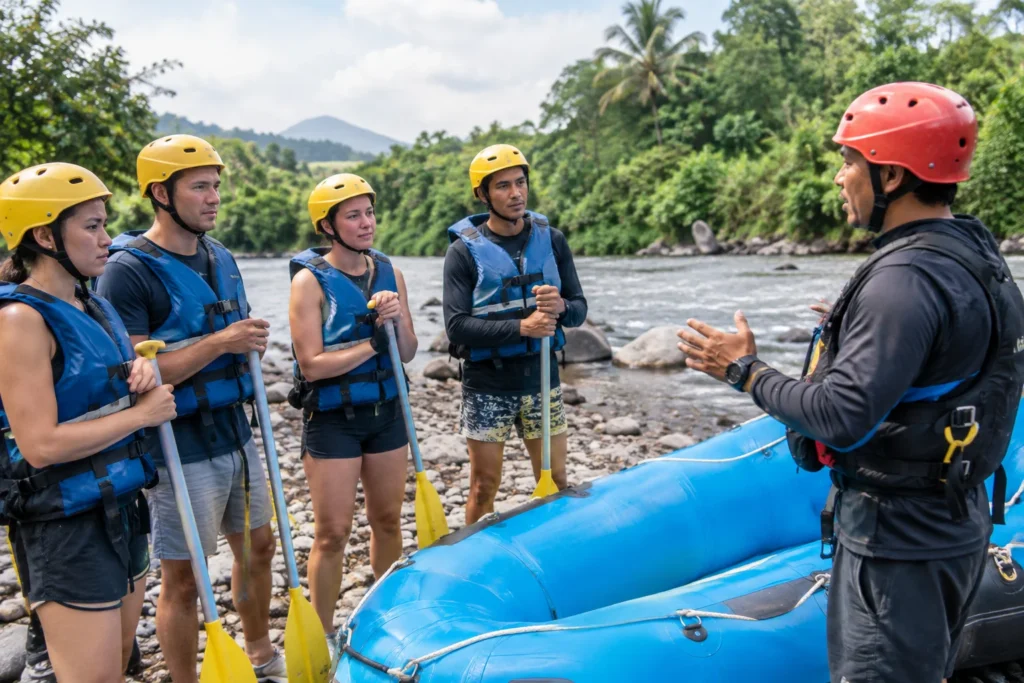
Before a Bali white water rafting trip begins, there is usually a moment when the paddles are still on the ground, everyone is gathered near the raft, and the guide starts explaining what to do on the river. It may look like a simple introduction, but this safety briefing is one of the most important parts of the experience. It gives you the basic knowledge to paddle as a team, respond to instructions and understand what to do if you leave the raft unexpectedly.
If you are searching for a Bali rafting safety briefing, you probably want to know what the guide will teach, whether you need previous experience and how much you are expected to remember. The reassuring answer is that you do not need to arrive as an expert paddler. You do need to listen carefully, ask questions when something is unclear and follow the guide’s instructions throughout the trip.
This guide explains the usual topics covered before a commercial rafting trip, with practical examples for first-time visitors. Exact procedures, commands and rescue arrangements can vary between operators, river sections and conditions, so treat your own guide’s briefing as the authority on the day.
A raft is a team boat. The guide may steer and manage the route, but the passengers still play an active role. Coordinated paddling helps the raft move as intended, while clear responses to commands help the group deal with changing water and obstacles. When the river is noisy, there may be little time for a long explanation in the middle of a rapid.
A good briefing turns unfamiliar instructions into actions you can recognise. It also gives the guide a chance to check that everyone understands the basics before the raft leaves the launch area. New Zealand’s WorkSafe guidance for commercial white water rafting says key safety topics should be demonstrated and practised, including swimming positions, paddling commands, raft positioning and rescue techniques. The precise format in Bali may differ, but the principle is useful: listening is important, and seeing a demonstration makes the instructions easier to remember.
Think of the briefing as your short orientation to the river, not a formality to sit through while thinking about lunch.
The guide will normally introduce themselves, explain the general plan and tell the group how the trip will run. This may include the route, approximate time on the water, where the group will stop, and what happens at the finish point. The guide may also explain how the group should behave around the launch and landing areas.
Use this moment to mention anything that could affect your participation. If you are unsure about your swimming ability, feel uncomfortable in deep water, have an injury or need an instruction repeated in a different way, tell the guide before departure. You do not need to announce private medical details to the whole group; ask to speak with the guide discreetly.
Your personal flotation device (PFD), often called a life jacket, and helmet should be fitted before you enter the river. The guide or crew should explain how the equipment is worn and check that it is secure. A PFD that is too loose may ride up; a helmet that moves around can offer less reliable protection.
Do not adjust straps in a way that makes the equipment uncomfortable or difficult to secure. Ask for help if a buckle is confusing, a strap is twisted or the fit does not feel right. Keep the equipment on for the period instructed by the operator, including when moving around the riverbank or waiting near the water.
For a closer look at the role of helmets and flotation equipment, read our guide to rafting safety equipment and standards in Bali.
The guide should show you how to hold the paddle, including the position of both hands and how to keep control of the T-grip at the top. The T-grip matters because an uncontrolled paddle handle can strike another passenger. Keep one hand on the shaft and the other controlling the top grip as demonstrated.
You may be shown a basic forward stroke, a backward stroke and how to stop paddling. The guide may also explain how to keep your paddle blade in the water and work with the people sitting beside you. You do not need a powerful athletic stroke. A controlled movement at the right time is usually more useful than paddling as hard as possible.
Operators use short commands so a group can respond quickly. The exact words are not universal, so learn the meanings used by your guide rather than assuming every company uses identical terminology. Common examples may include:
Do not guess what a command means. If you cannot hear it clearly during the briefing, ask the guide to repeat it and demonstrate the movement. A few seconds of clarification on shore is much better than confusion in moving water.
Your guide will show you where to sit and how to keep your feet positioned. Follow the exact method demonstrated for that raft. The aim is to stay balanced, avoid slipping and keep your body in a position from which you can respond to commands. Do not change seats, stand up or put your feet into unfamiliar gaps without the guide’s permission.
Some guides may ask passengers to hold designated safety lines or handles when approaching rougher water. Use only the handholds they identify. Avoid grabbing another passenger, the guide’s equipment or a loose rope as a substitute for a proper handhold.
This is often the question first-time rafters are most nervous about. The guide should explain the operator’s procedure for an unplanned swim before the trip starts. Listen carefully because the correct response can depend on the river, the location and the guide’s rescue plan.
In many white-water settings, a guide may teach a defensive swimming position for moving downstream: keep your feet up and pointed downstream, use your arms to help steer, and look where you are going. The purpose is to protect your feet from being trapped against the riverbed and help you navigate to a safer position. You may also be shown when and how to swim actively towards a safe area, but do not choose a route across the current unless the guide’s instructions and conditions make it appropriate.
One important rule commonly emphasised in white-water safety is not to stand up in moving water. Even water that looks shallow can exert enough force to trap a foot between rocks. Stay in the position taught by your guide and follow their directions. If you are separated from the raft, look for the guide and listen for instructions rather than trying to recover your paddle or other equipment.
For a step-by-step explanation of the situation, see what happens if you fall out of a raft in Bali.
The briefing may cover how a swimmer is brought back to the raft, how passengers can help from a safe position and what to do if a guide uses a throw rope. The demonstration should make clear that a rope rescue is not an invitation to grab or wrap a rope around your body. Follow the guide’s exact instructions and do not attempt a rescue technique you have not been taught.
Passengers may be asked to help by reaching with a paddle or assisting someone back into the raft, but only when the guide directs them to do so. The guide is responsible for coordinating the response. Your job is to stay calm, listen and avoid creating a second problem while trying to help.
Some operators also explain what happens if a raft becomes unstable or flips. The response may include moving clear of the boat, looking for the guide and following the recovery instructions. Do not assume that every flip or swimmer situation is handled in exactly the same way. Ask your guide to explain the procedure for the trip you are taking.

Rapids can be loud. Water noise, distance and the position of the raft can make spoken instructions difficult to hear. Guides may therefore use clear gestures, paddle signals or whistles. There is no reason to memorise every signal used by professional river teams, but you should understand the basic signals your guide plans to use with passengers.
For example, a guide may use a raised hand or paddle to get attention, point towards a direction, or use a specific gesture to communicate that the group should stop or move. Whistle systems also vary. One organisation may use a particular number of blasts for attention while another uses a different convention. This is why the briefing should tell you what the signals mean on your trip.
The International Rafting Federation publishes resources on river safety and communication, while Paddle Australia notes that signals and whistle meanings should be covered with the group before departure. You can explore the International Rafting Federation river safety resources and Paddle Australia safety guidelines for broader context.
Tell the operator before booking and tell your guide again during check-in. Being unable to swim does not automatically mean every rafting trip is suitable, nor should you assume that a life jacket removes every water-related risk. The operator needs to assess the river section, current conditions, trip requirements and its own participation policy.
Ask whether the selected route is appropriate for a non-swimmer, what flotation equipment is provided and what the guide expects passengers to do if they enter the water. If you feel uncomfortable after hearing the explanation, it is reasonable to pause and reconsider rather than feeling pressured to join.
Our separate article explains the considerations in more detail: can non-swimmers do white water rafting in Bali?
You do not need to turn the briefing into a classroom exam, but a few sensible questions can clear up uncertainty. Ask:
If English is not your first language, say so. A responsible guide should make reasonable efforts to communicate clearly, demonstrate important movements and check that the group understands. WorkSafe’s commercial rafting guidance specifically recommends checking understanding and using visual briefing material when a passenger is having difficulty following the explanation.
Do not rush from the vehicle straight to the raft expecting to catch up while everyone else is listening. Allow time for registration, changing, equipment fitting and the briefing. If you are arranging transport, confirm the pickup and check-in schedule with the operator in advance.
When the guide demonstrates a paddle stroke or body position, look at the movement rather than only listening to the words. Then practise it once if invited. This is particularly useful if you have never held a rafting paddle before.
Tell the guide if your helmet presses painfully, your PFD feels loose, you are struggling to understand a command or you are worried about a specific part of the trip. Small concerns are easier to address before the raft is on the river.
The safety talk is not the end of the instructions. Guides may give additional directions at the launch point, before a rapid or when river conditions change. Keep your attention on the guide throughout the trip and do not copy another passenger if their action conflicts with the instruction you have just received.
Usually, the briefing is designed for the people taking that particular trip, including guests who have never rafted before. You are not expected to know technical river language in advance. The most important things are to understand the commands used by your guide, know how your equipment should fit, follow the seating and paddle instructions, and remember the response explained for an unplanned swim.
That said, beginner-friendly does not mean risk-free. White water is a natural environment and conditions can change. The guide’s briefing, suitable equipment, sensible decisions and passenger cooperation all contribute to managing risk. No article can replace the operator’s on-site assessment or the instructions given by the guide leading your trip.
Choosing a trip is easier when you understand the river, the journey to the rafting base and what is included in the package. Compare the Bali white water rafting options, check the route and inclusions, and ask the operator any questions you still have before confirming. You can also explore the latest information and booking details through our rafting Bali booking page.
Once you arrive, give the briefing your full attention. Learn the commands, check your equipment and speak up if something is unclear. Then you can focus on what you came for: paddling through Bali’s beautiful river scenery with a guide and a team who know how to work together.
The duration varies by operator, group size and the topics that need to be covered. Allow enough time for the guide to explain and demonstrate equipment, paddle commands, raft positions and emergency procedures. Do not ask the guide to rush through important instructions.
No previous rafting experience is normally needed for a beginner trip. The guide should explain the basic techniques and commands before departure. Ask for a repeat demonstration if anything is unclear.
A proper pre-trip safety talk should explain the operator’s procedure for an unplanned swim and how passengers should respond. The exact technique depends on the river and trip, so follow the instructions given by your own guide.
Not necessarily. Some commands may be familiar across operators, but wording, signals and procedures can differ. Learn the system explained by your guide rather than relying on assumptions from another rafting trip.
Yes. Ask the guide to repeat a command, demonstrate a movement or explain the rescue procedure if you are unsure. It is better to clarify something on shore than guess once the raft is moving.
Learn the visual or whistle signals explained during the briefing and watch the guide closely. If you are unsure what a signal means, ask before departure. Never invent your own interpretation of a signal.
No activity on moving water is completely risk-free. A correctly fitted PFD is an important piece of safety equipment, but it does not replace the guide’s instructions, suitable river conditions, a properly managed trip or your own attention.
Instant confirmation • Licensed operator • Zero stair climb on Ayung
Book Now Chat on WhatsApp