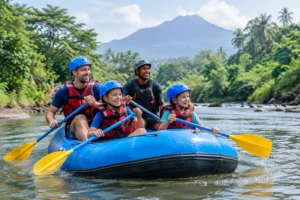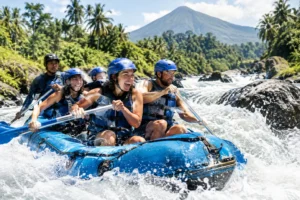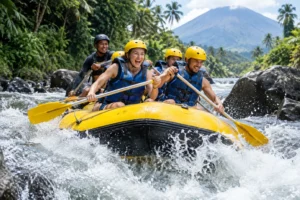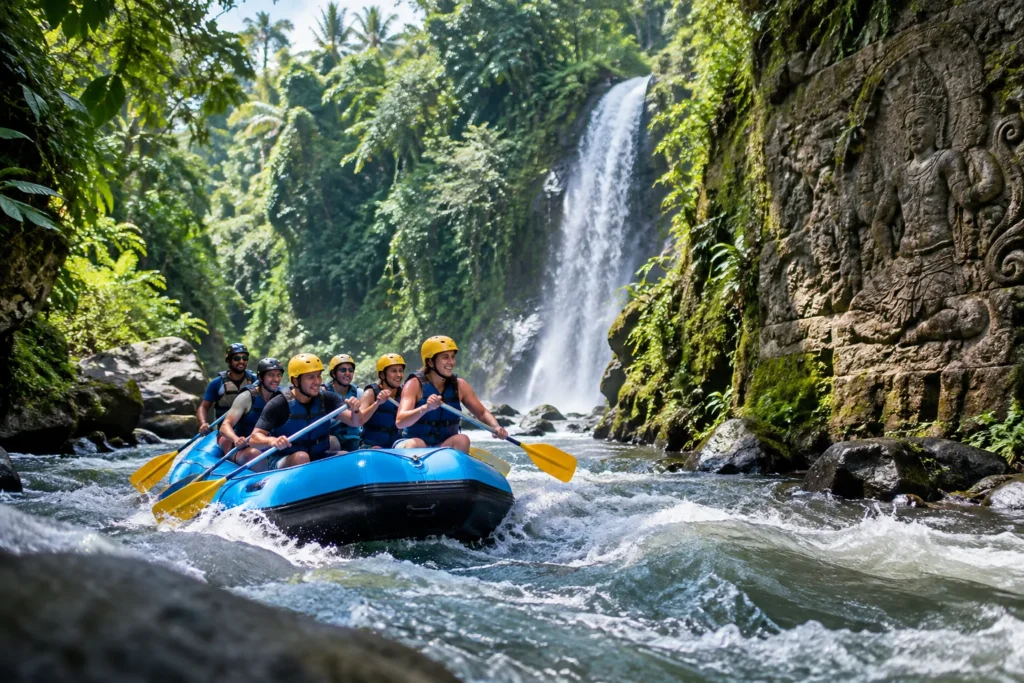
People often picture Bali as beaches, beach clubs and the occasional volcano at sunrise. Then they reach the Ayung River and discover a different side of the island: a green valley, steep riverbanks, tropical vegetation, splashing water and stretches where the river is the loudest thing around. The scenery is a big part of the appeal of Ayung River rafting in Bali, especially for travellers who want an outdoor experience without spending the whole day far from Ubud.
But what do you actually see from the raft? Is it all rapids, or are there waterfalls, rice fields and stone carvings too? This guide focuses on the landscape and visual highlights along an Ayung rafting trip, how conditions can change what you see, and how to enjoy the river without treating it like a floating photo studio.
The Ayung is one of Bali’s major river systems. Its wider watershed reaches from the island’s upland areas towards the south, crossing several regencies before reaching the coast. The Bali provincial spatial-planning agency describes the Ayung watershed as an important source for water supply, irrigation and tourism. That scale helps explain why a rafting outing can feel removed from the busy roads and cafés around Ubud: you are travelling through one part of a much larger living river landscape.
Commercial rafting sections used by visitors are generally in the Ubud and Kedewatan area, but each operator has its own launch point, route and finish arrangements. Do not assume every company follows an identical stretch. If a particular waterfall, carving panel or rest stop matters to you, ask whether it is on the route for your departure rather than relying on a photograph from a different rafting base.
For broader context, the Indonesian tourism authority’s Ayung River destination guide describes the river as a rafting location with varying difficulty levels. The practical point for visitors is simple: the Ayung is both a natural landscape and an active waterway, not a purpose-built amusement ride.
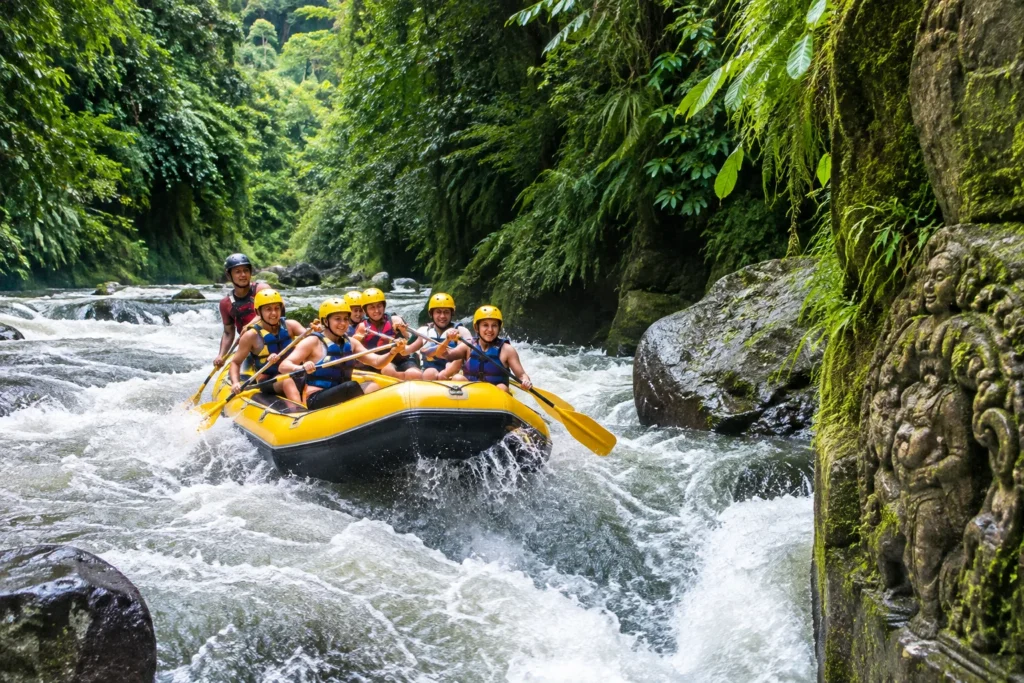
One of the first things many guests notice is how enclosed the river valley can feel. From the road, Ubud may look like a patchwork of villas, shops, rice fields and villages. Down at river level, the view changes. The banks rise on either side, vegetation hangs over the water, and the canopy can make parts of the route feel shaded even when the day above is bright.
You may see broad-leaf plants, vines, palms, bamboo and trees growing along the slopes. The exact vegetation changes with the bank, sunlight and local land use. Think of the scenery as changing green textures rather than a guaranteed botanical checklist. The river-level view is also different from a roadside viewpoint: you are low in the landscape, looking up at the banks and forward along the bends. That perspective is part of what makes Ayung rafting memorable, even on calmer stretches.
Water is not limited to the main channel. Depending on the route and recent rainfall, you may pass small streams, trickles and cascades coming down the valley sides. The official Indonesia Travel feature on Ayung rafting also highlights refreshing waterfall areas as one of the experience’s scenic attractions.
Set realistic expectations. A waterfall visible on one operator’s route may not be included on another. Flow changes through the year: after rain, a side stream can look fuller; during a drier spell, the same feature may be much thinner. A guide may pause near a suitable spot when conditions, timing and group safety allow, but a stop is never something to demand in the middle of a busy rapid.
If a waterfall moment matters to you, ask whether the selected route passes a waterfall or cascade, whether there is normally an opportunity to stop, and whether the guide may change the plan because of water level or crowding. Those questions are more useful than assuming every promotional image represents every trip.
One of the most distinctive visual features associated with some Ayung rafting sections is the carved stone artwork along the riverbank. Visitors may see long relief panels set into the stone, with figures and scenes inspired by the Ramayana. The Indonesian tourism authority specifically mentions stone carvings depicting the Ramayana among the cultural details that can be seen during an Ayung rafting outing.
These carvings add a cultural layer to the scenery. Instead of looking only at water and trees, you may find yourself following a sequence of figures and scenes along the bank. They are a reminder that Bali’s visual culture is not confined to galleries, temples and performance stages; artistic work can appear in unexpected places.
Still, do not assume every panel is ancient, that every raft passes every section, or that the guide will have time to explain the full story. Visibility depends on the route, water level, river traffic and the direction in which the raft approaches them. If you want to understand what you are looking at, ask the guide politely when the group is in a safe, calm section.
For background, read the Indonesia Travel overview of Ayung rafting and its cultural scenery. Treat it as a broad destination guide, not a promise that every operator uses the same route.
Some descriptions of the Ayung landscape include rice fields and cultivated slopes. Whether you see a clear paddy view from the raft depends on the section you travel and how the river bends through the valley. At times, the banks are thick with vegetation; elsewhere, the land may open enough to reveal a cultivated patch or a glimpse of a terrace above the river.
Water has a much bigger role in Bali than simply making a rafting trip possible. The island’s traditional subak system connects irrigation, farming communities, water temples and local cultural practice. UNESCO’s description of the Cultural Landscape of Bali Province and the subak system explains how canals, weirs, temples and rice-growing areas are linked through cooperative water management and the philosophy of Tri Hita Karana.
That UNESCO-listed cultural landscape is not a claim that your rafting route passes through a World Heritage component site. The listed areas are specific places, including the Pakerisan watershed and other named landscapes. The useful connection is broader: Bali’s rivers and water systems have shaped both its natural environment and cultural history. A rafting trip offers a close-up view of a river; it is not a substitute for visiting a subak landscape or water temple.
The scenery is not only what sits on the banks. The river itself changes character as the raft moves downstream. A stretch of riffles may lead into a wider pool, followed by a bend or a rapid where water folds around rocks. Light, reflections and the colour of the water can change from one section to the next.
Commercial rafting routes on the Ayung are often described as suitable for beginners and intermediate participants, but river difficulty is not fixed. Rainfall, water level, route selection and local operating decisions matter. Do not rely on a grade or description copied from a different month as a guarantee of what you will experience on your date.
If you want a comparison of the two best-known rafting rivers, our guide to Ayung versus Telaga Waja rafting explains how the rivers differ in overall character. For a route-focused look at the Ayung, see the Ayung River route, distance and duration guide.
Rain can make side streams and cascades more visible, deepen the sound of the river and change the colour of the water. In drier periods, some small flows may shrink, while the main river continues to move. Neither season guarantees a better-looking trip. The experience depends on current conditions and the operator’s decision about whether the route is suitable. Our guide to what happens when it rains on your Bali rafting day explains why rain does not automatically mean a trip is cancelled, but why conditions must be assessed.
Ayung rafting is offered by multiple operators, and their routes, access points, rest stops and finish areas are not necessarily identical. A photograph from one base may show a feature that is not on another company’s section. Confirm the route and what is included rather than choosing solely from a dramatic image.
It is tempting to look around constantly, especially when a carved panel or waterfall appears. But the guide’s instructions come first. Keep your paddle under control, stay in the position you were shown and look where the guide tells the group to look when approaching a rapid. You will have calmer stretches in which to take in the valley.
Do not stand up or lean far outside the raft to frame a photograph. Do not release your paddle or grab a rock, branch or wall unless the guide specifically instructs you to do so. If the group stops in a safe area, ask before moving or taking a picture. The guide knows the current and the raft’s position better than a passenger trying to compose a perfect shot.
Before departure, the guide should explain the equipment, paddle commands, raft positions and what to do if someone falls into the water. If you want to know what that talk normally covers, read our Bali rafting safety briefing guide. Enjoy the views, but never let a view distract you from a direct instruction.
A waterproof action camera with a secure mount or wrist attachment is more practical than holding an unprotected phone. Ask the operator whether cameras are allowed and whether restrictions apply to mounts or selfie sticks. Never use a camera in a way that stops you following paddle and safety commands. If the guide allows photos during a calm stretch, wide shots that include the water, bank and canopy often show the valley better than close-ups. Some rafting bases offer photographers or sell images after the trip; ask how that service works and whether photos are taken on your exact route. For more advice, see our article on getting good rafting photos without risking your phone.
Wear quick-drying clothes that you do not mind getting wet. Secure footwear is important because access to the river may involve steps, uneven paths or slippery surfaces. Leave jewellery and unnecessary valuables at your accommodation, and follow the operator’s instructions about lockers and storage. Bring a change of dry clothes for after the trip and any personal items you need once you return to the base. Our Bali rafting packing checklist covers the practical essentials and the things that are better left behind.
It can be a good choice if you want an active way to experience Ubud’s river valley rather than a trip built only around the biggest possible rapids. The combination of moving water, green banks, occasional cascades and cultural details gives the route more variety than a simple paddle from point A to point B.
That does not mean every minute is a sightseeing cruise. You will still paddle, listen to the guide, move through rapids and get wet. The scenery is part of the adventure, not a separate attraction with guaranteed stops. If you prefer a more energetic river experience, compare the Ayung with Telaga Waja before choosing.
For an overview of the activity itself, our Ayung River rafting review covers the wider experience. When you are ready to compare dates and packages, check the Bali rafting options and booking information and confirm the exact route with the operator.
Depending on the operator’s route and current conditions, you may see forested riverbanks, steep valley walls, small waterfalls or cascades, occasional cultivated slopes, and carved stone panels inspired by Balinese storytelling. The exact features are not guaranteed on every departure.
Some route descriptions include waterfall or cascade areas. Whether your trip passes one, and whether the guide can stop nearby, depends on the launch point, route, water level and safety conditions. Ask the operator before booking if this is important to you.
Stone relief panels associated with the Ayung rafting landscape are mentioned by Indonesia’s official tourism site. Visibility depends on the section used and the direction of travel. Ask your guide about them when the raft is in a safe, calm area.
You may see cultivated slopes or glimpses of rice fields on some sections, but the route is not a guaranteed rice-terrace sightseeing tour. The valley is also heavily vegetated, and the view changes around each bend.
Do not assume that it is. UNESCO’s Cultural Landscape of Bali listing covers specific subak landscapes and water-temple sites, including the Pakerisan watershed. That listing does not mean every Ayung rafting section is within a designated component site.
Morning can offer pleasant light, but cloud, rain, route direction and shadows affect photography. Ask the operator about available departure times, then choose based on your schedule and the conditions.
Only if the operator permits it and you can protect it properly. A waterproof action camera secured as instructed is usually more practical. Never hold a phone or camera in a way that stops you following paddle and safety commands.
Ayung River rafting is an adventure, but the river valley is part of the reason the experience feels distinctly Balinese. Forested banks, changing water, occasional cascades and carved stone storytelling can turn a couple of hours on the river into a closer look at the island’s landscape and culture.
Keep your expectations flexible, ask which route you will take, and let the guide decide when it is safe to pause and look around. The best memory may be a splash through a rapid—or a quiet moment when the raft drifts past a green wall of the valley and you realise how different Bali looks from down on the water.
Instant confirmation • Licensed operator • Zero stair climb on Ayung
Book Now Chat on WhatsApp