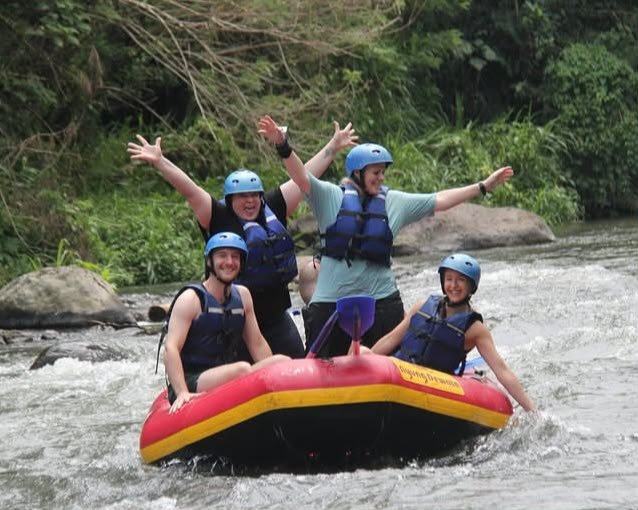
You have finally booked the trip. The confirmation email is in your inbox. But as the date gets closer, a little voice in your head starts asking questions: “What if I paddle on the wrong side? What if the raft flips? What if I am the only one who doesn’t know what they are doing?”
Take a deep breath. Thousands of guests join our Bali rafting tours for beginners every single year, and 99% of them have never held a paddle before in their lives. White water rafting is designed to be accessible. To help you shake off the nerves and maximize the fun, our senior river guides have put together this list of 11 insider tips specifically for first-timers.
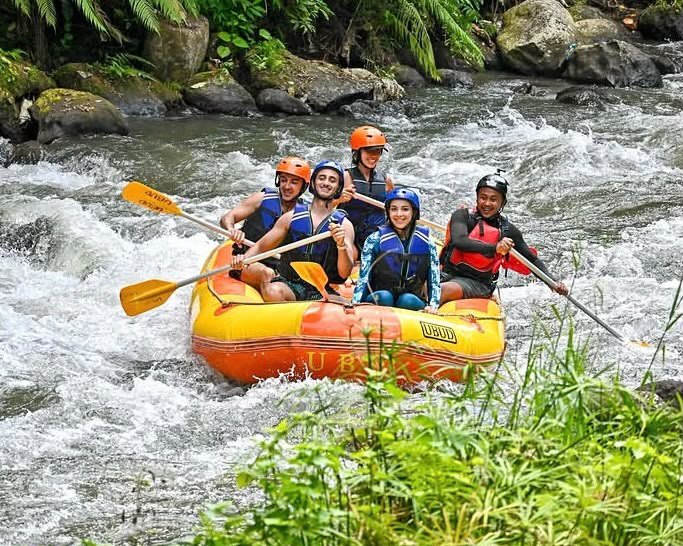
If this is your first time, do not book the afternoon slot. The morning water is clearer, the air is cooler, and you completely avoid the afternoon tropical rain showers. Read our full breakdown on why the morning slot always wins.
This sounds funny, but it is the #1 mistake first-timers make. Once you are strapped into a tightly fitted, ISO-certified life jacket and a helmet, going to the restroom becomes a major logistical hassle involving asking a guide to unbuckle you. Use the basecamp restroom immediately before you put your gear on.
Do not wear jeans, heavy cotton t-shirts, or expensive sneakers. You are going to get completely soaked within the first 5 minutes. Wear quick-dry activewear, a rash guard, board shorts, and secure sport sandals. If you are unsure, check our complete rafting outfit guide.
We know you want photos for Instagram. But holding a smartphone in a Grade III rapid is how phones go to die. Even waterproof pouches snap under the pressure of a heavy wave. Lock your phone in the basecamp safe and buy the professional photos taken by the riverside photographer at the finish line. They have telephoto lenses and get much better angles anyway.
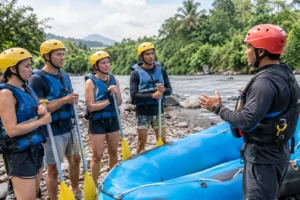
Your guide will spend 5 minutes explaining the T-Grip (the T-shaped handle at the end of your paddle). This is not just for paddling; it is a safety handle. When the guide yells “Hold on!”, you grab the T-Grip and the raft’s safety rope. Never let the T-Grip hit another guest in the face when the boat bounces.
The raft is not a free-seating restaurant. The guide will assign seats based on weight distribution and paddling strength. If you are a non-swimmer or a smaller child, the guide will seat you in the middle of the raft, which is the most stable position. Trust their placement.
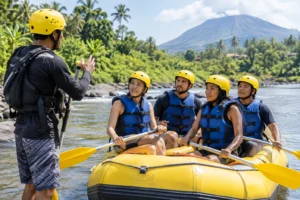
Rafting is an interval sport. When the guide yells “Forward paddle!”, you dig deep and paddle hard to punch through the wave. When the guide yells “Stop!” or “Hold on!”, you immediately stop paddling, grab the safety rope, and duck your head. Do not keep paddling when the boat is dropping down a steep rapid, or you will throw off the boat’s balance.
Falling out is rare, but if it happens, do not panic and do not try to stand up. According to wilderness water safety protocols taught by the National Outdoor Leadership School (NOLS), the universal defensive swimming position in moving water is on your back, with your feet pointing downstream and elevated toward the surface (“nose and toes to the sky”). This allows your feet to bounce off any rocks while your life jacket keeps your head above water. Your guide will throw a rescue rope or paddle you back in within seconds.
River water is natural and generally safe for your skin, but you do not want to swallow a mouthful of it when hitting a massive wave. When you see a wall of white water coming, take a deep breath, close your mouth, and brace for the splash.
First-timers often worry that the raft will pop like a pool toy. As we detailed in our safety equipment standards guide, commercial rafts are made of heavy-duty, multi-chamber PVC. You could scrape it against a volcanic rock all day and it will not pop. Relax and let the boat do the work.
Your river guide is part safety guard, part comedian, and part photographer. They work incredibly hard in the sun and water to ensure your family has the best day possible. If they did a great job, a tip of IDR 50,000 to IDR 100,000 per raft at the finish line is a highly appreciated gesture of thanks in Balinese culture.
The anxiety of the “unknown” is always worse than the actual experience. Within 10 minutes of launching, the nerves will completely vanish, replaced by pure laughter and adrenaline. You do not need to be an athlete or an expert to enjoy the river; you just need to listen to your guide and hold on tight.
🌊 Book Your First Bali Rafting Trip via WhatsApp
You do not need to be an elite athlete, but a basic level of mobility is required. You need to be able to hold a paddle, follow simple physical commands, and sit in a rubber boat for about 2 hours. The Ayung River is very forgiving for average fitness levels.
Nothing bad! The guide sits at the back and steers the raft using a long oar. If you paddle on the wrong side, the guide will simply shout a correction or use their oar to overpower your stroke. You cannot “break” the raft by paddling wrong.
No. Some extreme rafting destinations in other countries have guides who intentionally flip boats for fun. In Bali, commercial rafting operators strictly prioritize safety and comfort. Guides will never intentionally flip the boat or push you out.
Instant confirmation • Licensed operator • Zero stair climb on Ayung
Book Now Chat on WhatsApp